Some objects reveal their story immediately. Others leave you with questions that make you want to look closer.
Our upcoming 27 & 28 October 2026 auction in Mortsel, Antwerp features a remarkable and visually powerful collection of African art, traditional carved figures, masks, sculptural objects and ethnographic collectibles.
Every object has its own presence.
Expressive carved faces. Tall standing figures. Masks combining wood with fibre and decorative elements. Sculptural forms shaped by hand. Surfaces showing colour, texture, wear and character.
Together, they form a collection that immediately invites curiosity.
For collectors of African traditional art, ethnographic art, carved wooden sculpture, masks and cultural artefacts, this is a section of the October auction that deserves careful attention.
A Collection Full of Individual Character
Unlike mass-produced decorative objects, traditional carved works often reveal the individuality of their maker through proportion, expression, surface and detail.
Look across this collection and no two faces are alike.
Some are highly stylised.
Others are dramatically expressive.
Some figures appear monumental despite their relatively compact size, while others incorporate fibres, beads, pigment or additional decorative materials that add texture and visual complexity.
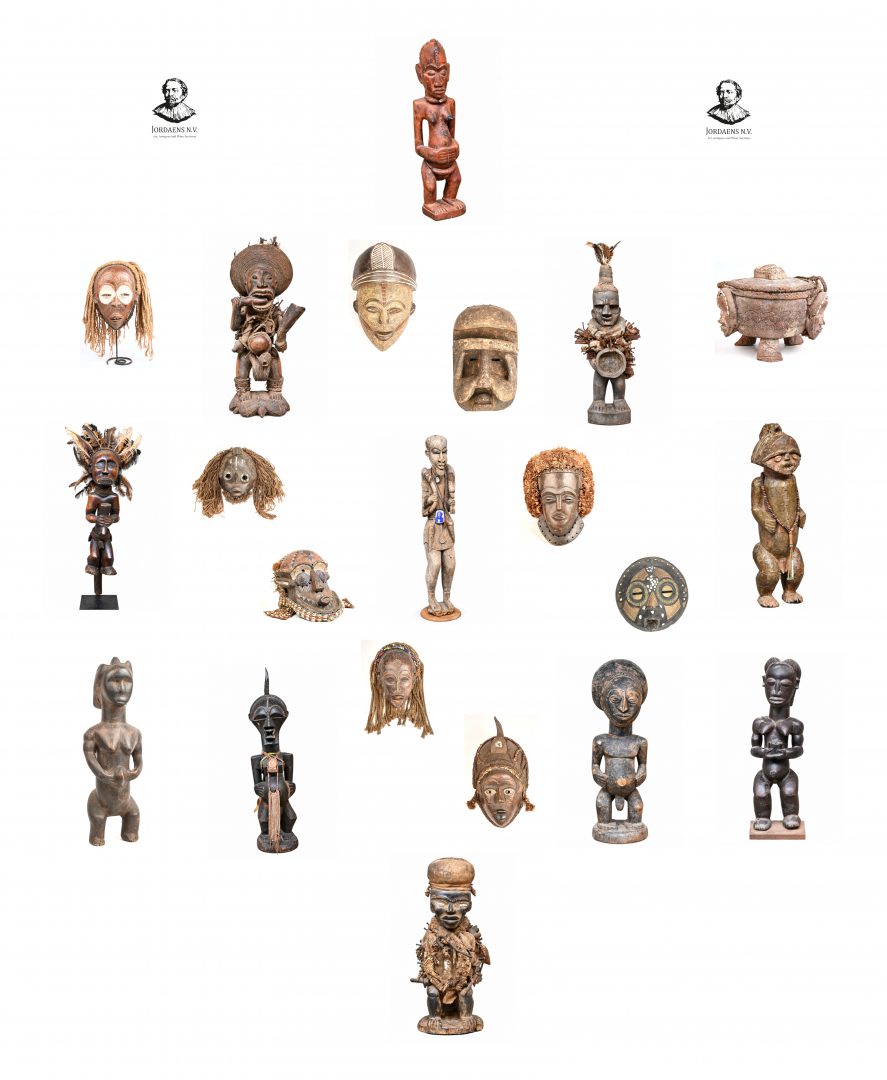
Among the objects pictured are:
• Traditional-style African masks
• Carved wooden standing figures
• Male and female figurative sculptures
• Masks with fibre or hair-like attachments
• Polychrome and pigment-decorated masks
• Sculptural figures with applied decorative elements
• Seated and standing ancestor-style figures
• Carved ceremonial-looking objects
• A decorative lidded vessel or container
• Highly expressive wooden heads and masks
• Figurative sculptures displayed on stands
The visual variety alone demonstrates how broad the field of African and ethnographic art can be.
More Than Decoration: Objects With Cultural Context
Traditional African sculpture cannot always be understood simply by looking at form.
Depending on its origin, an object may historically have been associated with ancestry, status, community ceremonies, protection, initiation, storytelling, spirituality or everyday cultural life.
But visual similarity alone is not enough to determine a specific object’s original meaning.
That is why serious collectors look beyond appearance.
They investigate:
Where was it made?
Which cultural tradition produced it?
When was it collected?
Who owned it previously?
Was it created for local use or later for the collecting market?
Are there collection labels, records or documented provenance?
These questions transform an interesting sculpture into an object with context.
Prospective bidders should therefore consult the individual catalogue entries for confirmed information regarding origin, cultural attribution, material, date, provenance, dimensions and condition.
The Extraordinary Power of the Mask
Masks are among the most visually recognisable forms associated with traditional African art.
But there is no single “African mask style”.
Across a continent containing thousands of communities and artistic traditions, masks can differ dramatically in shape, materials, symbolism and function.
This collection illustrates that diversity beautifully.
Some faces are elongated and serene.
Others feature large eyes or strongly emphasised mouths.
Several incorporate fibres or other applied material.
Some are highly naturalistic, while others reduce the human face to a series of powerful geometric shapes.
For collectors, these differences are precisely what make the field so fascinating.
A mask can be appreciated first as sculpture — but understanding its origin can reveal an entirely deeper layer of meaning.
Carved Figures: Expression Through Form
The standing figures in this auction are equally compelling.
Notice how posture alone changes the personality of each sculpture.
Some figures stand rigidly and frontally.
Others bend their knees or hold objects.
Hands may rest on the abdomen, chest or sides.
Heads may be proportionally enlarged.
Facial expressions range from calm and introspective to highly animated.
These are not accidental details.
In many traditional sculptural traditions, proportion and posture do not necessarily attempt to reproduce the human body realistically. Instead, individual features can be emphasised because of their visual, social or symbolic importance.
That makes these sculptures particularly interesting to collectors accustomed to European academic traditions, where realism historically played a very different role.
Texture, Patina & Evidence of Age
One of the most compelling qualities of carved wooden objects is their surface.
Wood changes over time.
Handling, environmental exposure, pigments, oils, dust, repairs and age can all affect appearance.
Collectors therefore pay close attention to:
• Surface patina
• Wear patterns
• Tool marks
• Pigment and colour
• Cracks and losses
• Older repairs
• Added fibres or attachments
• Bases and undersides
• Collection numbers or labels
However, appearance alone should never be treated as proof of age.
Artificial ageing and later decorative treatments exist, which is another reason provenance and specialist catalogue information can be so important when evaluating ethnographic art.
Provenance Matters
For serious collectors of African and ethnographic art, provenance can be as interesting as the object itself.
An established ownership history can tell us when an object entered a European collection, where it was previously acquired and how it moved between collectors.
Useful provenance information may include:
• Previous private collections
• Dealer or gallery labels
• Old auction records
• Collection inventory numbers
• Exhibition history
• Historic photographs
• Acquisition documentation
• Import or export records where applicable
Collectors should always review the available provenance and catalogue information associated with an individual lot rather than relying solely on stylistic appearance.
Why African Art Has Influenced the Wider Art World
Traditional African sculpture has had an enormous influence on the development of modern art and design.
European artists in the early 20th century encountered African masks and sculpture whose approaches to abstraction, proportion and representation differed radically from European academic conventions.
The resulting encounter helped change how generations of artists thought about the human figure.
Today, African traditional art is collected on several levels.
Some collectors focus intensely on a particular region or artistic tradition.
Others collect masks.
Some specialise in figurative sculpture.
Others are primarily drawn to the extraordinary visual strength these objects can bring to an interior.
Powerful Objects for Contemporary Interiors
One of the fascinating things about ethnographic sculpture is how naturally it can work within contemporary spaces.
A single carved figure on a minimalist pedestal can become the strongest object in a room.
A traditional mask against a plain wall can have more impact than a large decorative print.
A carefully curated group of figures can create a museum-like display within a private home.
This is why African art attracts not only specialist collectors but also architects, interior designers and buyers searching for statement pieces with individuality.
The most successful interiors often combine objects from different periods rather than recreating one historical style.
Traditional sculpture beside contemporary furniture.
Old wood against concrete.
Organic surfaces against clean architecture.
The contrast allows both objects to become more powerful.
What Should Collectors Examine During Viewing?
Our public viewing days offer an opportunity to examine details that photographs cannot fully communicate.
When looking at ethnographic art, consider inspecting:
The back and underside – old labels or collection markings can sometimes be found away from the main viewing surface.
The wood and construction – observe carving methods, joins, cracks and repairs.
Pigment and surface – colour, residue and wear can reveal valuable information.
Applied materials – fibres, beads, shells, metal or other attachments may form an important part of the object.
️ Labels and inventory numbers – these can occasionally provide clues to earlier ownership.
Provenance – always compare the physical object with the information provided in the catalogue.
⚠️ Condition and restoration – examine old breaks, replacements or losses carefully.
Exact cultural attribution, age, function and authenticity should be based on documented catalogue information and specialist examination rather than photographs alone.
African Art & Ethnographic Collectibles at Auction in Belgium
This collection may be particularly interesting to people searching for:
African art auction Belgium, African masks for sale, African sculpture auction, ethnographic art Belgium, traditional African art, African wooden figures, antique African masks, African tribal art auction, carved African figures, ethnographic masks, African collectibles, African sculpture collectors, ritual art, traditional wood carving, African decorative art, primitive art auction, ethnographic objects, estate African art collection, African art Antwerp and online African art auction.
While some of these phrases — particularly “tribal art” and “primitive art” — remain established search terms within the international collecting market, we prefer the more precise descriptions African traditional art and ethnographic art wherever possible.
Come Face to Face With the Collection
These objects are especially rewarding to view in person.
Photographs can show shape.
They cannot fully convey scale, surface, carving depth, patina and presence.
We therefore invite collectors, dealers and interested visitors to see the collection during our public viewing days.
VIEWING DAYS
Friday 23 October 2026
Saturday 24 October 2026
AUCTION DAYS
Tuesday 27 October 2026
Wednesday 28 October 2026
Jordaens N.V. – Mortsel, Antwerp, Belgium
Please consult each individual lot description for confirmed information regarding cultural attribution, country or region of origin, period, provenance, materials, dimensions and condition.
Which Face Draws You In?
Look at the collection one more time.
Which piece did your eye return to?
The tall central figure?
One of the fibre-framed masks?
The strongly geometric faces?
The expressive standing figures?
Or perhaps one of the simplest sculptures?
That instinctive reaction is often where collecting begins.
First an object catches your attention. Then you want to know its story.
Explore the full October auction catalogue, examine your favourite pieces during our viewing days and join the bidding on 27 & 28 October.
Discover traditional art and craftsmanship
Research the objects that intrigue you
Examine them closely during the viewing
❤️ Save your favourite lots
Register and bid
Every face has a presence. Every object has a history. The next chapter may begin at auction.
Leave a Reply
You must be logged in to post a comment.