What can a label, a stamp and centuries of violin-making history tell us about one intriguing instrument?
Among the musical instruments appearing in our upcoming auction is this characterful old violin with bow and fitted wooden carrying case — a lot that immediately deserves the attention of violin collectors, musicians, dealers and enthusiasts of historic stringed instruments.
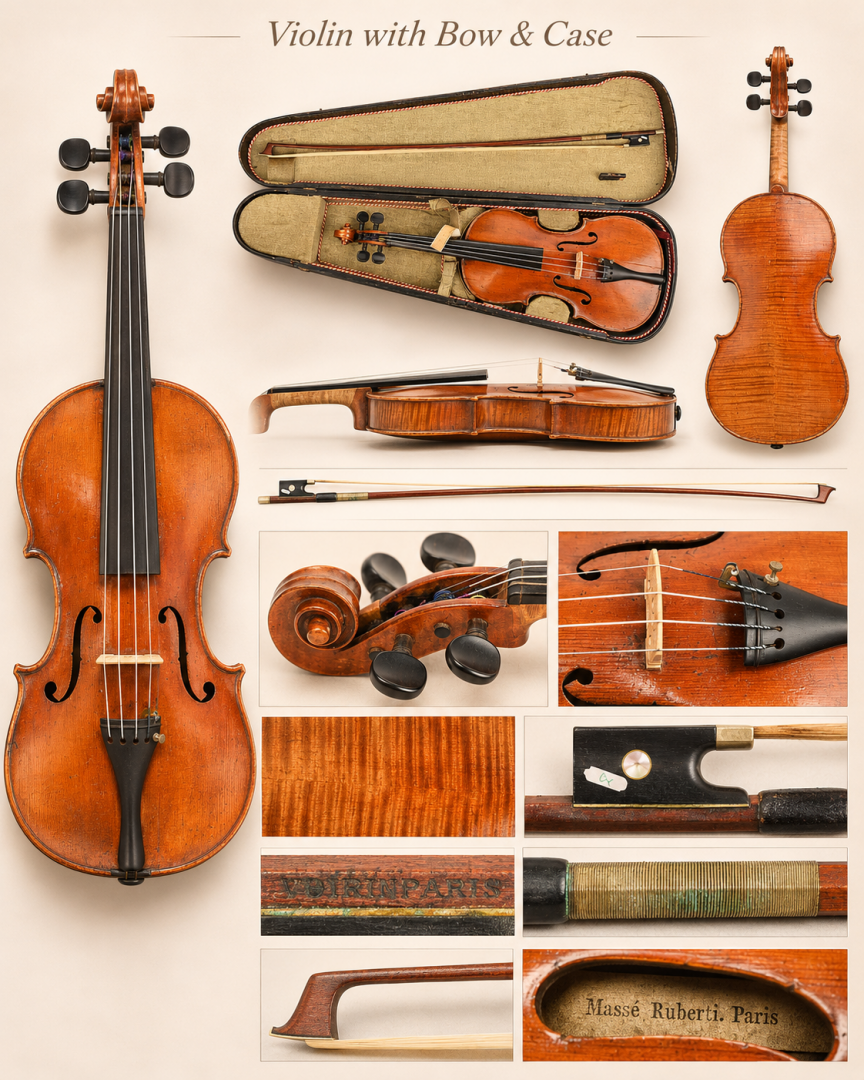
The violin bears an internal label reading “Francesco Ruggièri”, while the accompanying bow carries the inscription “Voirin Paris.”
Those two names alone are enough to make a knowledgeable collector look twice.
But as experienced instrument collectors know, labels and stamps are only the beginning of the story.
A Violin With Character
The photographs reveal an attractive old violin with warm amber-brown varnish and visible signs of age and use.
From its elegant outline and traditional f-holes to the dark fingerboard, scroll, tuning pegs and beautifully figured back, this is an instrument whose visual character has developed over many years.
Look closely and several details stand out:
Warm reddish-brown / amber varnish
Attractive figured wood visible across the back and ribs
Traditional violin construction with carved scroll and f-holes
Visible age-related wear and patina
Dark fingerboard, tailpiece and tuning pegs
Original-style fitted wooden carrying case
Accompanying bow with visible stamp
️ Internal violin label
For collectors, these small details matter.
A violin is not simply a musical instrument. It is a combination of woodworking, acoustics, craftsmanship, history and musical culture.
The Label: “Francesco Ruggieri”
Inside the violin is a label bearing the name “Francesco Ruggièri.”
That name is historically important.
Francesco Rugeri, also written Ruggieri, was a significant violin maker working in Cremona, Italy, during the 17th century and is associated with the great Cremonese tradition of stringed-instrument making. His surviving instruments are highly regarded by musicians and collectors.
However, this distinction is extremely important:
A label bearing a historic maker’s name does not by itself establish that an instrument was made by that maker.
Labels were copied, replaced and reproduced extensively throughout the history of violin making.
For that reason, we describe this particular instrument accurately as:
“An old violin bearing a label reading ‘Francesco Ruggièri’.”
Its exact maker, period and attribution should be assessed independently by a qualified violin expert or luthier.
That uncertainty is not unusual in the world of old violins.
In fact, researching an unidentified or labelled instrument is part of what makes collecting them so fascinating.
The Bow: Marked “Voirin Paris”
The accompanying bow provides another intriguing detail.
The stick carries an inscription reading “Voirin Paris.”
François Nicolas Voirin was one of the notable French bow makers of the 19th century. Born in Mirecourt in 1833, he later worked in Paris, including for the celebrated workshop of Jean-Baptiste Vuillaume, before establishing his own workshop. His bows became highly regarded for their elegant construction and playing qualities.
Again, collectors should interpret the stamp carefully.
Specialist references specifically note that Voirin’s brand was also used after his lifetime and was frequently copied.
The correct auction description is therefore:
“Bow bearing the inscription/stamp ‘Voirin Paris’.”
It should not be considered an authenticated François Nicolas Voirin bow solely on the basis of the stamp.
For a knowledgeable bow collector, however, that marking certainly makes the piece worthy of closer examination.
Look Closely at the Bow
The accompanying photographs show several details useful to prospective buyers.
The bow displays:
• A dark wooden stick
• A black frog
• A circular decorative eye to the frog
• Metal winding around the handle section
• A visible “Voirin Paris” marking
• A traditional bow head and tip
• Natural signs of age and use
As with any historic bow, important questions include the material of the stick, fittings, weight, dimensions, straightness, repairs, originality of components and attribution.
Collectors and musicians are therefore strongly encouraged to examine the bow in person during viewing.
Beautiful Figuring to the Back
Turn the violin over and another appealing feature becomes visible.
The back shows pronounced figured or flamed wood, creating shifting bands of light across the surface.
This effect is especially attractive under changing light and is one of the visual characteristics collectors often appreciate in traditionally constructed violins.
The ribs also display figuring, adding further visual depth around the body.
Of course, attractive wood alone does not establish quality or origin.
But it certainly contributes to the instrument’s presence.
The Scroll: A Violin Maker’s Signature in Wood
For collectors and luthiers, the scroll can be one of the most fascinating parts of an old violin.
The carved spiral at the top of the instrument may look purely decorative, but the way it has been shaped can provide clues about the hand or workshop responsible for making an instrument.
The close-up photographs show:
• The carved volute
• Pegbox construction
• Four dark tuning pegs
• Tooling and surface wear
• The transition between neck and pegbox
Serious violin specialists often study the scroll alongside the f-holes, arching, purfling, corners and internal construction when assessing an instrument.
Why Old Violins Are So Fascinating to Collect
Few collectibles combine so many different disciplines.
An old violin can be studied as:
Decorative art – through its outline, varnish and craftsmanship
Woodworking – through carving, construction and choice of timber
A musical instrument – whose ultimate purpose is sound
A historical object – carrying evidence of previous generations
A research subject – where labels, construction and provenance must be investigated
A working instrument – if its condition and setup allow it to be played
That is why the market for antique and vintage violins attracts musicians as well as collectors.
A musician may search for tone and playability.
A collector may focus on origin, maker and craftsmanship.
A dealer or luthier may notice construction details that others overlook.
One instrument can appeal to all three.
What Should You Examine During Viewing?
Old violins should ideally be inspected in person.
Photographs provide valuable information, but they cannot fully communicate weight, construction, setup or playing characteristics.
During viewing, prospective bidders may wish to examine:
The internal label
Look at the wording, typography and placement.
The body
Inspect the front, back, ribs, corners and edges.
The wood
Examine the figuring and grain under different light.
The scroll and pegbox
Look closely at carving and construction.
The f-holes and arching
These can contain important stylistic information.
️ Repairs and restoration
Older instruments frequently have repaired cracks or replacement components.
The bow
Inspect the stamp, frog, winding, head and stick carefully.
The case
The fitted carrying case accompanies the instrument and contributes to the overall lot.
Playability
Anyone intending to use the violin as a working instrument should arrange an appropriate professional assessment.
A Name Connected to Cremona
For violin enthusiasts, Cremona carries enormous historical significance.
The Italian city became synonymous with violin making through families and makers including Amati, Stradivari, Guarneri and Rugeri.
Francesco Rugeri belonged to this remarkable Cremonese tradition and worked during one of the most important periods in the development of the violin.
The presence of a “Francesco Ruggièri” label in this instrument therefore provides an interesting research point — while remaining exactly that until specialist attribution is established.
A Bow Name Connected to Paris
The “Voirin Paris” inscription creates a second historical connection.
François Nicolas Voirin became an important figure within 19th-century French bow making, working in Paris and developing a reputation for elegant, refined bows.
This means one auction lot brings together two names associated with two of Europe’s great centres of string-instrument craftsmanship:
Cremona and Paris.
Whether these markings ultimately prove to indicate maker, workshop, later attribution or simply historic labelling is precisely the question that makes close examination so interesting.
A Lot for Violin Collectors, Musicians & Instrument Enthusiasts
This violin may particularly appeal to buyers searching for:
antique violin auction Belgium
old violin for sale Belgium
violin labelled Francesco Ruggieri
Francesco Rugeri violin label
Ruggieri violin auction
Voirin Paris bow
old violin with bow and case
antique violin bow
French violin bow
Cremonese violin
vintage violin Belgium
collectible musical instruments
string instrument auction
violin auction Antwerp
musical instrument auction Belgium
These long-tail terms help specialist buyers discover the lot without making an unsupported attribution.
See the Violin in Person
For an instrument of this nature, physical inspection is strongly recommended.
VIEWING DAYS
20 & 21 November
AUCTION DAYS
24 & 25 November
Jordaens N.V. – Mortsel, Antwerp, Belgium
Examine the violin, label, bow stamp, case, wood, construction and condition before bidding.
Buyers wishing to establish maker, period, authenticity, playing condition or attribution should seek an independent professional opinion from a qualified violin expert or luthier.
What Story Is Hidden Inside This Violin?
Perhaps it is the warm old varnish that attracts you first.
Perhaps the beautifully figured back.
Perhaps the words “Francesco Ruggièri.”
Or perhaps it is that small “Voirin Paris” stamp on the bow.
Whatever catches your attention, this is precisely the sort of auction lot that encourages closer investigation.
A violin can survive generations.
It can pass from musician to musician, house to house and country to country — accumulating wear, repairs, memories and unanswered questions along the way.
And sometimes, those unanswered questions are what make an old instrument irresistible.
Explore the complete auction catalogue
Study the detailed photographs
Inspect the instrument during viewing
❤️ Save the lot to your favourites
Register and bid